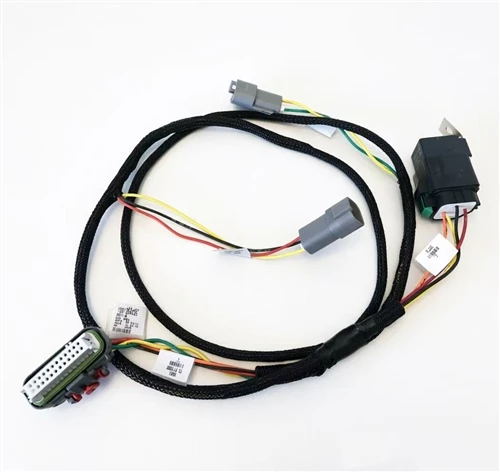
In the B2B wire harness manufacturing industry, we often hear a common refrain: "Cables are just pathways for current, aren't they? As long as they conduct electricity, that's all that matters."
But in high-power applications such as new energy systems, medical devices, or industrial automation, this mindset is extremely dangerous. A wire is not simply a "water pipe." The flow of current through it is governed by strict physical laws. If you choose the wrong AWG wire gauge, you are not just risking equipment failure-you are inviting burnouts, fires, and costly product recalls.
Today, Mingching's senior engineers will take you through the critical-and potentially life-or-death-relationship between AWG and current capacity.
I. The Inverse Logic of AWG: Smaller Number, Bigger Wire?
First, we need to clarify the basic logic behind AWG (American Wire Gauge). For those new to this, AWG numbers are counterintuitive: the smaller the number, the thicker the wire.
- A 10 AWG wire is significantly thicker than a 24 AWG wire.
The science behind it: The cross‑sectional area of a conductor determines how many electrons can flow through it simultaneously. A larger cross‑section means lower electrical resistance-and this physical property directly defines a cable's ampacity (current‑carrying capacity).
II. Core Physics: Why Is "Heat Generation" the Number One Killer?
Why does a thinner wire cause trouble? The answer lies in the well‑known Joule's Law:
P = I² × R
Where:
- P = heat generated (watts)
- I = current (amperes)
- R = resistance (ohms)
- The thinner the wire, the higher its resistance (R).
- The effect of current (I) is squared-when current doubles, heat generated quadruples.
When you try to push high current through a fine‑gauge wire, the conductor heats up as quickly as a heating element. If the heat exceeds the thermal tolerance of the insulation, disaster begins.
III. From Wrong Selection to Catastrophe: The Four Stages of Progression
The consequences of selecting the wrong wire gauge are usually a chain reaction, unfolding in four stages:
1. Voltage Drop → System "Shutdown" (the mildest consequence)
Due to excessive resistance in the undersized wire, current is lost during transmission. The voltage reaching the end equipment drops, leading to reduced motor power, sensor errors, or frequent controller resets.
2. Insulation Degradation and "Brittleness"
Prolonged overheating, even without immediate fire, rapidly ages plastic insulation materials such as PVC. They become hard, brittle, and develop cracks, exposing the inner conductor.
3. Terminal/Burnout at Connection Points
The weakest link in any wire harness is often the crimp terminal. Mismatched wire gauges cause poor crimping or high contact resistance. In actual failure cases, we often see that while the middle of the harness looks fine, the connector ends have charred to black carbon.
4. Thermal Spread and Unstoppable Fire
When melted insulation causes a short circuit, or when the overheating conductor ignites nearby convoluted tubing and tape, a fire erupts. Inside enclosed industrial cabinets or vehicles, such fires spread rapidly and are extremely difficult to extinguish.
V. Best Practices: How Do Professionals Make the Right Choice?
To ensure your B2B project is foolproof, we recommend following these standard procedures:
Define both rated current and peak current: Do not look only at the average; consider in‑rush surge currents during startup.
Allow 20%–30% safety margin: Never operate a cable at 100% rated load continuously.
Choose the correct insulation material: Use silicone or PTFE/Teflon for high‑temperature environments, and high‑quality PVC for general conditions.
Perform temperature‑rise testing: During the prototyping phase, measure the harness surface temperature under actual load-this is the most direct validation.
Wire gauge selection is not merely a mathematical exercise-it is a matter of safety. In the precision‑driven world of high‑power applications, there is no room for "good enough."
Mingching is dedicated to providing high‑performance customized wire harness solutions to customers worldwide. Our engineering team can engage from the early design stage, offering precise electrical selection recommendations and reliable crimping processes-ensuring every harness we deliver remains rock‑solid even under the harshest conditions.
Need professional wire‑harness design advice or free samples?
👉 Contact our technical experts or submit your RFQ online today.