In smart energy-saving home heating solutions, the control harness often has to work reliably under prolonged high temperatures. Inside an efficient heating unit, temperatures can be far higher than those in ordinary household appliances. Using standard PVC wires would cause the insulation to age quickly, soften, or even melt, leading to short circuits or fire hazards. Mingching recently customized a signal control harness for a French engineering company focused on heating systems, and the design logic is worth sharing.
The harness is terminated with XH-2.5-6P connectors on both ends. It contains six wires in total: two 22AWG red/black silicone wires for power positive and negative, and the remaining four in other colors (or all white) for temperature sensors, control signals, etc. Silicone insulation is chosen because it can continuously withstand 200℃, whereas ordinary PVC fails above 80℃. Inside a heating appliance, positions near heating elements or heat exchangers can easily reach 150℃ or higher – silicone wire is the foundation for long-term reliability.
Beyond the wire insulation, the entire bundle is protected by an outer fiberglass sleeve. Fiberglass itself can tolerate over 500℃ and offers excellent thermal insulation and flame resistance. It not only prevents external heat sources from damaging the wires but also contains any potential wire overheating. To prevent the cut ends of the fiberglass sleeve from fraying or unravelling, heat-shrink tubing is applied at both ends. This improves appearance and securely seals the fiberglass fibers, avoiding irritation to installers.
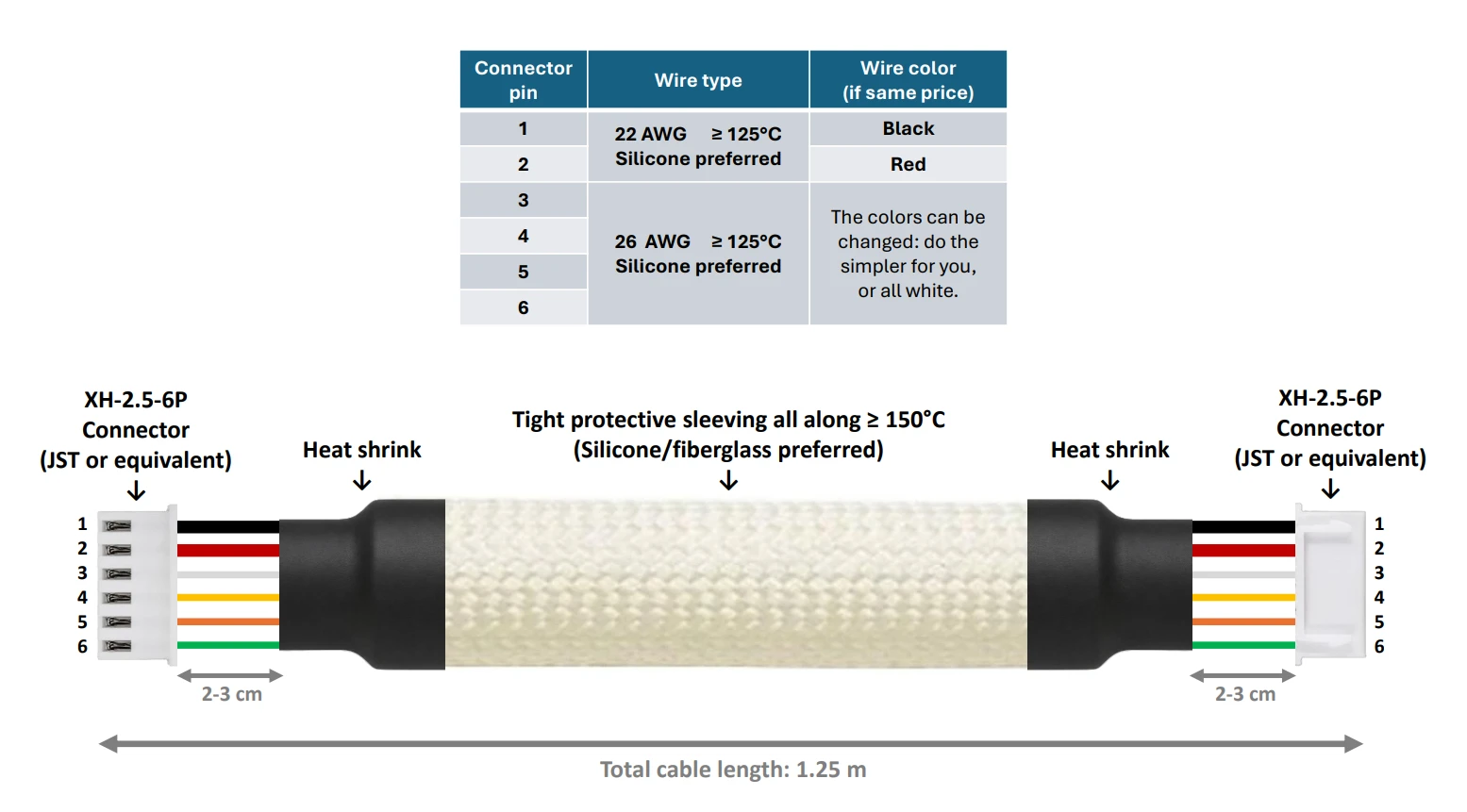
Regarding wire gauge selection, the customer asked whether using a single gauge (for example, 26AWG for all six cores) would simplify production and lower cost. Here we need to clarify a common misunderstanding: the smaller the AWG number, the larger the conductor diameter. 22AWG has a cross-section of about 0.33mm², while 26AWG is only 0.13mm². The current-carrying capacity of 22AWG (≈7A) is much higher than that of 26AWG (≈3A). The power supply loop in a heating device may need to carry 2-5A – using 26AWG would cause noticeable voltage drop and self-heating. Although 22AWG has a slightly higher material cost, it provides a necessary safety margin. Moreover, thicker wires are actually easier to crimp and yield higher production quality. From a system reliability perspective, choosing 22AWG is both necessary and cost-effective.
In summary, this dedicated heating equipment harness meets the challenges of high-temperature environments through 200℃-rated silicone wire, flame-retardant fiberglass sleeving, heat-shrink reinforcement, and the proper 22AWG gauge selection. If you are developing a similar heating or thermal control device, feel free to contact us for a custom solution.
Need a high-temperature harness for your heating or thermal equipment? Let us know your operating temperature, current requirements, and connector type – Mingching will provide a drawing and sample proposal within 24 hours.