Cryptocurrency mining machines run continuously around the clock, drawing high currents. A US customer, when customizing a power harness for mining machines, specifically emphasized the reliability requirements under continuous high-current operation. Under such extreme duty cycles, the power harness is not a passive cable – it is a critical component that directly affects operational safety and hash rate stability. A poorly designed or manufactured harness can cause voltage drops, intermittent connections, overheating, or even fire. This article uses a custom mining machine power harness as an example to explain its key parameters and why each one matters.
The Role of the Custom Harness in a Mining Rig
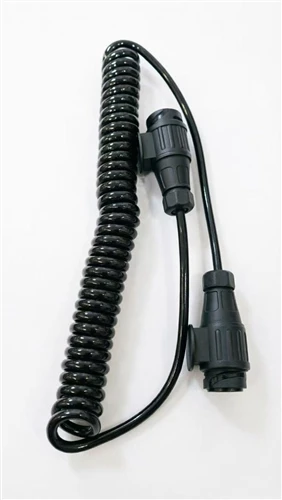
The power harness connects the power supply unit (PSU) to the mining motherboard or hash boards. It must deliver stable, uninterrupted current to each board while withstanding constant vibration, moderate heat, and possible cable flexing during maintenance. The harness we custom-build for mining applications uses 2.5mm² 4-core RVV / SJT cable, 1 meter in length, with an LP-C04PP-01-001 connector on one end and an ANEN SA2-30 connector on the other.
Critical Parameters and Why They Matter
1.Conductor Cross-section – 2.5mm² (approx. 13-14 AWG)
What it means: Determines the maximum continuous current capacity.
Why it matters: A typical mining hash board draws 10-15A at 12V. Undersized conductors (e.g., 1.5mm²) would overheat, increase resistance, and cause voltage drop. 2.5mm² copper safely handles up to 20A in free air and 15-16A inside a chassis, providing a safe margin for continuous operation.
2. Contact Resistance – ≤5 mΩ per crimp
What it means: Measures the quality of the terminal-to-wire connection.
Why it matters: High contact resistance generates localized heat (I²R loss). At 15A, a 10 mΩ crimp dissipates 2.25W of heat inside the connector – enough to raise temperature by 20-30°C, accelerating oxidation and potentially leading to thermal runaway. Our crimps are held to ≤5 mΩ, verified by milliohm meters.
3. Crimp Pull-Force – ≥8 kgf (78 N) for 2.5mm²
What it means: Indicates mechanical integrity of the crimp.
Why it matters: During installation or maintenance, cables may be tugged. A weak crimp can partially pull out, increasing resistance or breaking the circuit. We follow IPC/WHMA-A-620 Class 2 standards (minimum 8 kgf pull-force for 2.5mm² stranded wire), ensuring robust mechanical retention.
4. Insulation Resistance – ≥10 MΩ at 500V DC
What it means: Confirms that no leakage current flows between conductors or from conductor to ground.
Why it matters: In a dusty, warm mining environment, insulation can degrade. Low insulation resistance causes leakage currents that may trip power supplies or cause erratic hash board behavior. Our harnesses are tested at 500V DC to guarantee >10 MΩ.
5. Dielectric Strength – Withstand 1500V AC for 1 minute
What it means: Verifies insulation can survive voltage spikes without breakdown.
Why it matters: Power supplies can generate transients. A harness that fails dielectric strength could short out, destroying the mining rig. Passing this test ensures safety margins for the life of the equipment.
6. Connector Mating Cycle – Rated ≥500 insertions
What it means: Specifies how many times the connector can be plugged/unplugged without performance degradation.
Why it matters: Miners often swap or service hash boards. Low-cycle connectors may develop loose contacts after a few dozen cycles. Our LP-C04PP and ANEN SA2-30 connectors are designed for ≥500 cycles, maintaining stable contact resistance over years of use.
7. Temperature Rating – -20°C to +80°C (cable and connectors)
What it means: Defines the safe operating temperature range.
Why it matters: Inside a mining chassis, ambient temperatures often reach 50-60°C, and the harness itself adds heat from I²R losses. Standard PVC insulation softens above 70°C, leading to deformation and increased leakage risk. Our materials maintain mechanical and electrical integrity up to 80°C, with safety margin.
8. Shielded or Unshielded? – Unshielded for DC power
What it means: For DC power transmission, shielding is not required.
Why it matters: Adding shielding increases cost and stiffness with no benefit for pure power delivery. However, the 4-core design allows future use of two cores for power and two for low-speed communication (e.g., I²C monitoring), offering flexibility.
Why These Parameters Are Non-Negotiable for Mining
A mining farm operates 24/7/365. A single harness failure can halt dozens of hash boards, costing hundreds of dollars per day in lost revenue. More importantly, a failed harness – due to poor crimping or undersized wire – can cause arcing and fire, destroying thousands of dollars in equipment. By specifying and verifying each of the above parameters, we ensure that the harness becomes a passive, invisible, and completely reliable part of the mining rig.
Why Choose Mingching
As a cable factory in Shenzhen, we focus on application-driven custom harnesses:
✅ 2.5mm² 4-core RVV/SJT cable for true 15A+ continuous current
✅ LP-C04PP & ANEN SA2-30 connectors with high retention force
✅ 100% crimp pull-force and contact resistance testing
✅ Free samples for validation before mass production
✅ Small-batch orders accepted, fast turnaround
Get a Quote for Your Mining Power Harness
- Need a rugged, high-current power harness for your mining machines?
- Click here to provide your power rating, cable length, and connector requirements] – we will reply within 24 hours with a detailed spec sheet, drawing, and sample offer.