


Have you ever had this experience?
You drive your car to the dealership for routine maintenance. The technician plugs a diagnostic device into a port beneath the steering wheel, taps a few buttons, and instantly knows what's wrong with your car. Curious, you bend down to get a look at this mysterious connector yourself-only to spend several minutes searching in an awkward position without finding it.
Don't worry. Most people struggle to locate the OBD port the first time.
This 16-pin trapezoidal connector is actually hidden somewhere around the driver's seat-it's just remarkably discreet. In more than 80% of passenger cars, the OBD port is located beneath the steering wheel on the driver's side. Look above the brake or accelerator pedal, usually behind or inside a black plastic trim panel with a textured surface. On some vehicles, you simply need to gently pull back the edge of the panel to reveal it-no tools required. Run your hand around the area, and you'll usually feel a trapezoid-shaped connector.
If you can't find it beneath the steering wheel, check these common locations:
- Left side of the center console: Some models hide it behind a cover panel near the driver's knee.
- Under the front passenger glove box: Certain BMW, Mercedes-Benz, Audi (BBA) models and the Honda Odyssey place it on the passenger side.
- Inside the center armrest compartment: Some older Buick GL8 models and certain electric vehicles locate it at the bottom of the center console storage compartment.
Search in the order of driver's side → passenger side → center console, and you'll find the port in about 95% of cases. If it still remains elusive, consult your vehicle's owner's manual-it almost always shows the exact location.
Once you find it, you'll notice it's a 16-pin trapezoidal connector. But have you ever wondered: Why is it trapezoidal? Why does it have 16 pins? And what exactly is this connector called?
The Full Name and History of OBD
The official name of this connector is the OBD port.
OBD stands for On-Board Diagnostics. Simply put, it's the vehicle's built-in self-diagnostic system.
Its history dates back to the early 1980s.
In the early 1980s, the California Air Resources Board (CARB) introduced the first requirements for onboard vehicle diagnostics with one primary goal: reducing vehicle emissions. The original systems, later known as OBD-I, were developed independently by each automaker. This created several problems:
- Different diagnostic connectors
- Different fault code formats
- Different communication protocols
As a result, mechanics needed different diagnostic equipment for every vehicle brand, making repairs unnecessarily complicated.
A major breakthrough came in 1988, when the Society of Automotive Engineers (SAE) established the OBD-II standard, standardizing the physical design of the diagnostic connector. This specification became SAE J1962-the official standard that defines the 16-pin trapezoidal connector we still use today.
In 1996, the U.S. Environmental Protection Agency (EPA) made OBD-II mandatory for all gasoline-powered vehicles sold in the United States. From that point on, OBD-II became the common language of the global automotive industry.
China adopted similar regulations as well. Beginning July 1, 2008, all new Category I light-duty gasoline vehicles were required to be equipped with OBD systems. From July 1, 2010, the requirement was extended to all light-duty vehicles. In 2019, OBD inspections officially became part of China's mandatory vehicle inspection program.
So the small trapezoidal connector you see today represents more than three decades of standardization-from a fragmented landscape to a unified global diagnostic standard.
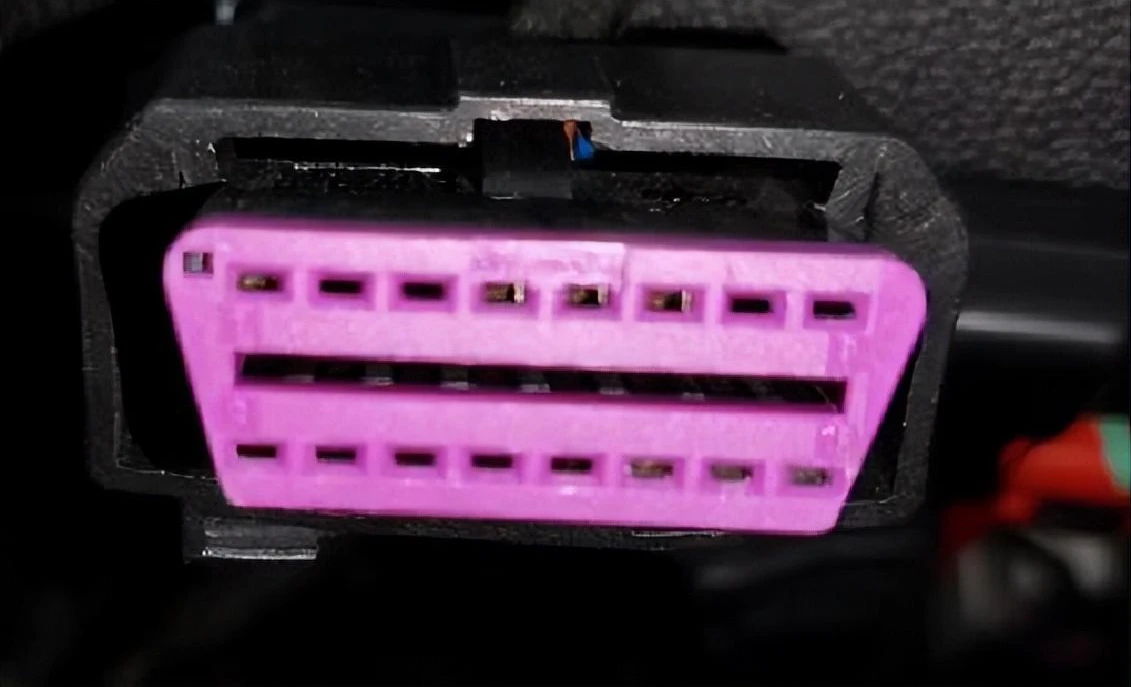
Let's take a closer look at the connector itself.
The OBD port uses a 16-pin Data Link Connector (DLC). Its trapezoidal shape isn't just for appearance-it prevents incorrect insertion. If the connector is facing the wrong direction, it simply won't fit, reducing the risk of damage or electrical shorts.
Each of the 16 pins has its own purpose:
| Pin | Function | Description |
|---|---|---|
| 1 | Manufacturer-specific | Used for proprietary functions |
| 2 | SAE J1850 Bus+ | Communication protocol used by older Ford and GM vehicles |
| 3 | Manufacturer-specific | - |
| 4 | Chassis Ground | Connected to the vehicle body |
| 5 | Signal Ground | Reference ground for diagnostic communication |
| 6 | CAN High (CAN-H) | Primary communication line for modern vehicles |
| 7 | K-Line | Diagnostic line used on older European and Asian vehicles |
| 8 | Manufacturer-specific | - |
| 9 | Manufacturer-specific | - |
| 10 | SAE J1850 Bus- | Works together with Pin 2 |
| 11 | Manufacturer-specific | - |
| 12 | Manufacturer-specific | - |
| 13 | Manufacturer-specific | - |
| 14 | CAN Low (CAN-L) | Paired with Pin 6 |
| 15 | L-Line | Used together with Pin 7 |
| 16 | Battery Positive (+12V) | Constant battery power for diagnostic tools |
Several pins are especially important:
- Pin 16 (+12V Battery Power): Supplies constant power directly from the vehicle battery to the scan tool.
- Pins 4 and 5 (Chassis Ground and Signal Ground): Both are essential for stable communication.
- Pins 6 and 14 (CAN Bus): Standard on virtually all vehicles built after 2008 and now the primary diagnostic communication channel.
- Pins 7 and 15 (K-Line and L-Line): Older communication lines commonly found on pre-2008 European and Asian vehicles.
Pins 1, 3, 8, 9, 11, 12, and 13 are manufacturer-defined. Some are unused, while others support functions such as immobilizer programming or waking up specific electronic modules.
The Connector That Talks to Your Car's "Brain"
After learning about the connector itself, you might wonder:
What is it actually connected to?
The answer is the ECU-the electronic "brain" of the vehicle.
ECU stands for Electronic Control Unit, commonly referred to as the vehicle's onboard computer. Modern vehicles contain dozens of ECUs: one for the engine, one for the transmission, another for the ABS braking system, and many more. Together, they control virtually every aspect of vehicle operation.
The OBD port serves as the gateway to these ECUs.
Think of it this way: the ECUs are the car's brains, while the OBD system is the language they use to communicate with the outside world. When a technician plugs a scan tool into the OBD port, the tool sends requests to the ECUs, which then return the requested information.
This information includes:
- Diagnostic Trouble Codes (DTCs): For example, P0300 indicates random or multiple cylinder misfires.
- Live Data: Engine RPM, vehicle speed, coolant temperature, oxygen sensor voltage, and much more.
- Vehicle Information: VIN (Vehicle Identification Number), emissions readiness status, and other system information.
Whenever a fault occurs, the relevant ECU records the error, stores it in memory, and often illuminates a warning light on the dashboard. By reading these stored trouble codes through the OBD port, technicians can quickly pinpoint the source of the problem instead of checking every system one by one.
This is also why the OBD port plays such an important role during vehicle inspections. During emissions testing, inspectors access the OBD system to verify that the vehicle's emissions-related systems are functioning properly.
It may look like nothing more than a small trapezoidal connector, but it provides direct access to the nervous system of the entire vehicle.
The next time you spot it beneath your steering wheel, it probably won't seem quite so mysterious.