


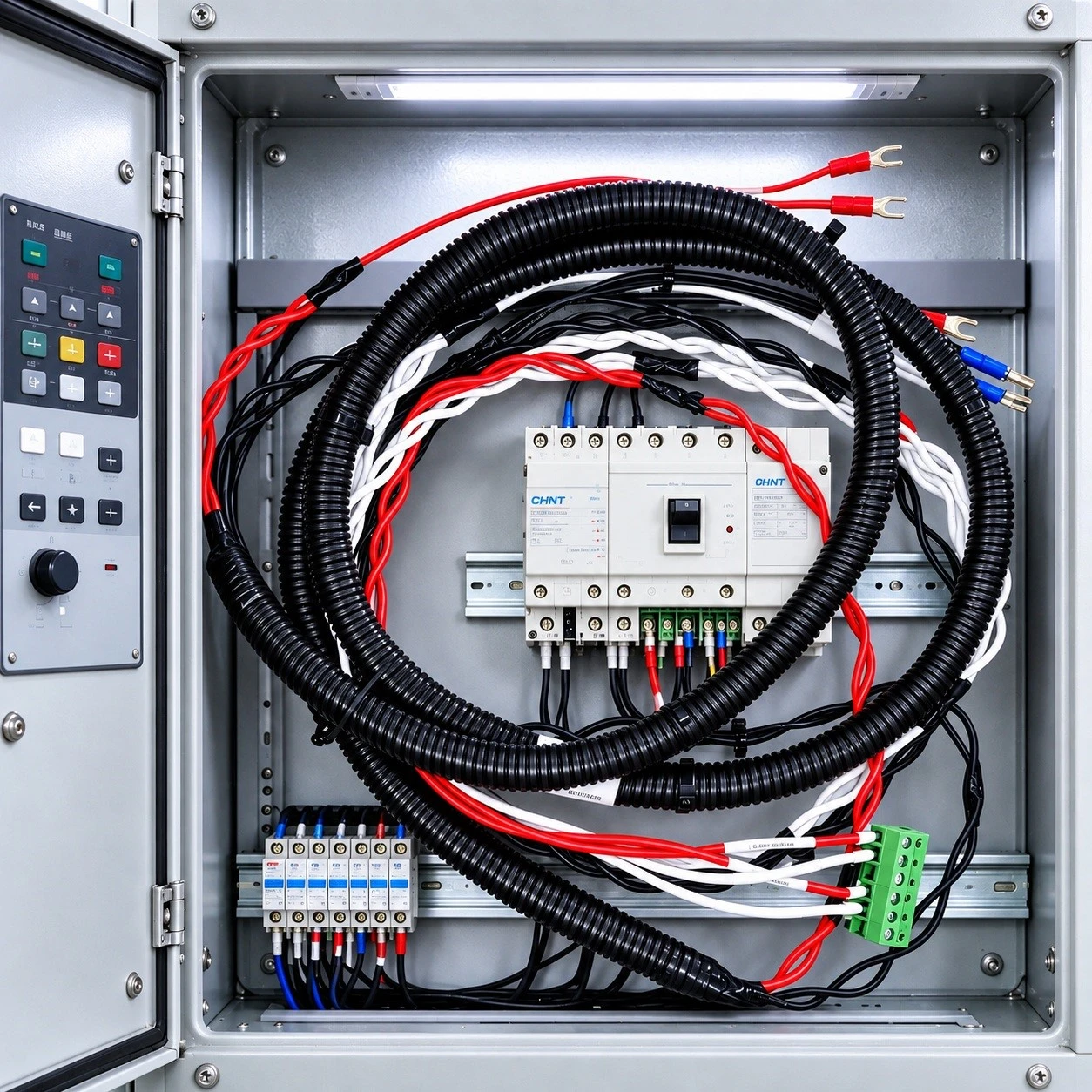
If you're building EV charging systems, power electronics equipment, or automation control panels, the wiring harness inside your enclosure is rarely the part that gets attention in a design review - until it fails in the field, or until your production line can't keep up with order volume. For OEMs scaling fast in energy infrastructure and industrial automation, sourcing the right industrial wiring harness manufacturer is a supply-chain decision with real consequences: field reliability, UL compliance, and whether your production can actually scale when demand does.
breaks down what to actually evaluate - whether you're wiring a PLC control panel wiring harness for a machine builder application, or a control cabinet wire harness for a modular EV fast-charging unit that has to survive rain, dust, and vibration in an outdoor depot.
What Counts as an Industrial Wiring Harness?
An industrial wiring harness bundles the control, signal, and power conductors inside an enclosure - whether that enclosure is a traditional automation control panel or a rack-style power electronics cabinet. It replaces manual point-to-point wiring with a pre-engineered, pre-tested assembly built to a specific schematic, wire length, and connector configuration.
The term covers a wide range of applications:
PLC control panel wiring harnesses for machine automation, material handling, and process control
Control cabinet wire harnesses for power electronics, EV charging infrastructure, and grid-connected equipment
High-current power distribution harnesses for medium-voltage and high-power (kW-to-MW class) systems
The engineering requirements shift depending on which category you're in - and that's exactly where a lot of OEMs get burned by choosing a generalist wire shop instead of a manufacturing partner who understands their specific application.
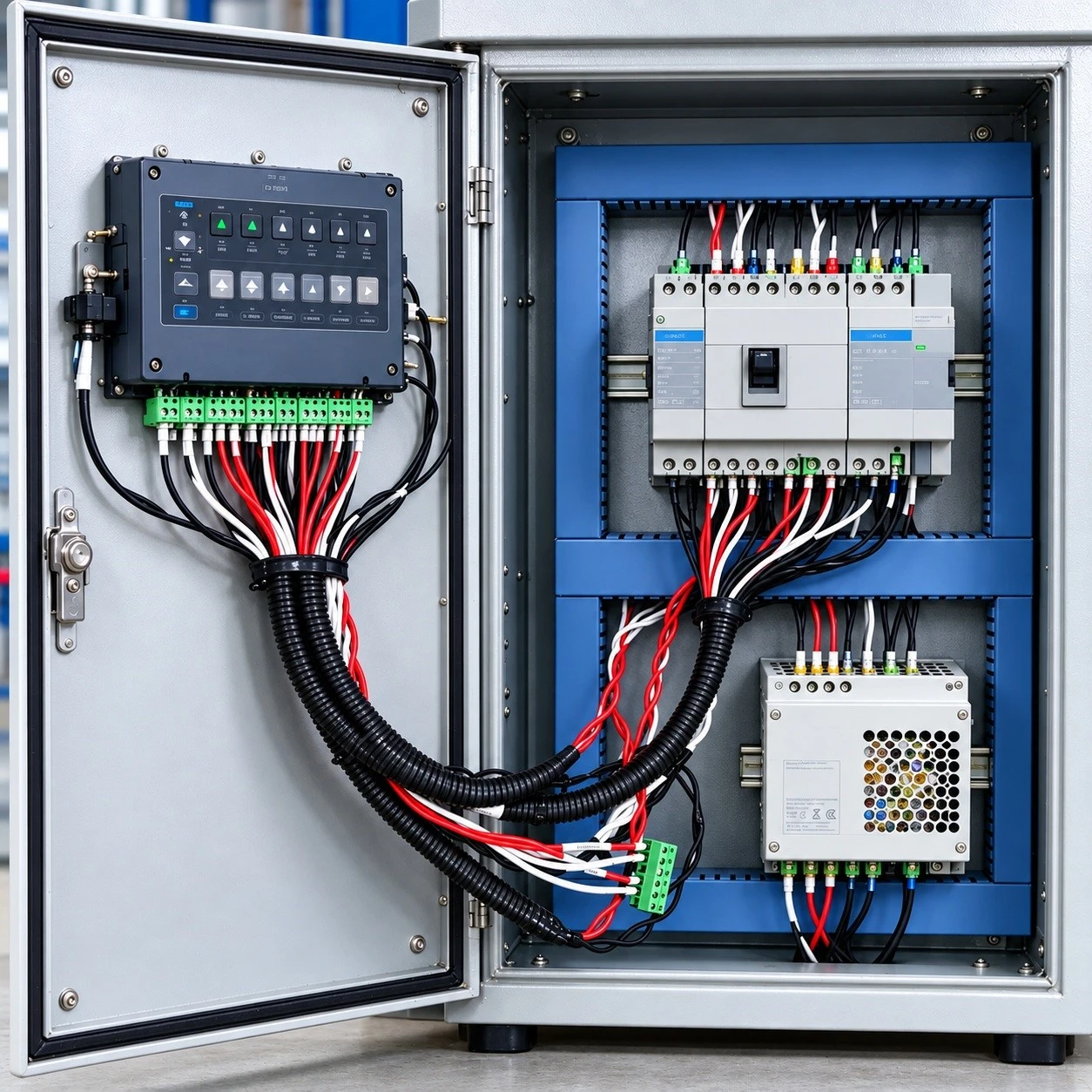
6 Criteria for Choosing an Industrial Wiring Harness Manufacturer
Engineering Support That Matches Your Application, Not a Generic Template
A manufacturer who only knows how to wire standard relay-and-PLC control panels will struggle when your product is a rack-mounted power conversion cabinet running hundreds of amps, or an outdoor charging enclosure that needs sealed, vibration-rated terminations. Ask potential suppliers directly: have they engineered control cabinet wire harnesses for high-power or outdoor-rated equipment, not just standard indoor automation panels?
Certifications That Actually Apply to Your Product
UL508A alignment and IPC/WHMA-A-620 workmanship standards are baseline requirements for any serious PLC control panel wiring harness supplier. If your product will carry a UL panel listing, your harness manufacturer's labeling, wire gauge selection, and termination methods need to support that certification path from day one - not get retrofitted after your first field audit.
Environmental and Ruggedization Capability
This is where many industrial automation-focused harness shops fall short for EV charging and power electronics OEMs. If your enclosure will sit outdoors - in a depot, at a charging hub, alongside grid infrastructure - your control cabinet wire harness needs wire insulation rated for temperature extremes, connectors sealed against moisture and dust ingress, and strain relief engineered for vibration and thermal cycling. A harness built for a climate-controlled machine shop floor is a different engineering problem than one built for a curbside DC fast charger.
High-Current and Power-Dense Wiring Experience
As power electronics and EV charging systems scale into the hundreds of kilowatts - and grid infrastructure equipment moves into medium-voltage territory - the power wiring inside the cabinet has to be sized, insulated, and terminated by someone who understands ampacity derating, connector current ratings, and thermal management at scale. This is a materially different skill set than wiring a standard 120/240V control circuit.
Testing and Traceability Built Into the Process
Every unit should undergo continuity testing, dielectric (hipot) testing, and insulation resistance verification before it ships - logged by serial number or batch. For OEMs shipping equipment into regulated or safety-critical applications (grid infrastructure, EV charging, industrial automation), that traceability record matters when something needs root-cause analysis six months after installation.
Production Capacity That Scales With Your Growth
This is the criterion OEMs underestimate most. Fast-growing energy infrastructure and EV charging companies don't have stable, predictable order volumes - they scale in bursts as new sites, contracts, or product lines come online. A harness manufacturer who can handle a 50-unit prototype run but chokes at 500 units per month isn't a long-term partner. Ask about typical lead times, how they handle volume ramp-up, and whether their tooling and fixtures are already qualified for your part number before you need the 10x order.
Common Mistakes OEMs Make When Sourcing Industrial Wiring Harnesses
Choosing on price per unit alone, without factoring in rework costs from inconsistent termination quality at scale
Assuming a "panel shop" and a "cabinet wire harness" supplier are interchangeable - the engineering, ruggedization, and current-carrying requirements differ significantly between standard automation panels and power-dense or outdoor cabinets
Skipping a prototype/pilot-run validation stage and going straight to volume production, which is where wiring errors compound fastest
Not asking about scale-up capacity until the order volume is already there and the current supplier can't keep pace
|
Criterion |
What to Ask a Supplier |
|
Application-specific engineering |
"Have you built harnesses for [outdoor cabinets / high-power systems / standard automation panels]?" |
|
Certifications |
"Is your process aligned to UL508A and IPC/WHMA-A-620?" |
|
Environmental rating |
"What IP-rated connectors and temperature-rated insulation do you stock?" |
|
Power capacity |
"What's the highest current/voltage harness you've built?" |
|
Testing |
"Is 100% continuity and hipot testing standard, or an add-on?" |
|
Scalability |
"What's your capacity to scale from prototype to 10x volume?" |
Where This Leads
Whether your product is a machine-mounted PLC control panel wiring harness or a ruggedized control cabinet wire harness for outdoor power electronics, the underlying question is the same: can this supplier engineer it correctly the first time, prove it with test data, and scale production without your team firefighting quality issues at volume?
If you're evaluating suppliers for your next industrial wiring harness program, take a look at our Control, Signal and Power Wiring Capabilities and our Engineering Support from Prototype to Production - built specifically for OEMs who need both application-specific engineering and the capacity to scale.