


A machine cable assembly connects a machine to its sensors, motors, drives and power supplies using jacketed, connector-terminated cables. An industrial wiring harness bundles many individual wires into one pre-formed, branched unit, most often inside an enclosure or along a fixed route. In short, a machine cable assembly is built around cables that travel between devices, while an industrial wiring harness is built around wires that stay in one place. Many machines need both, and this guide explains how to tell them apart and choose correctly.
Machine Cable Assembly vs Industrial Wiring Harness: Quick Comparison
|
Feature |
Machine Cable Assembly |
Industrial Wiring Harness |
|
Basic construction |
One or more jacketed cables with connectors on the ends |
Multiple individual wires grouped into a branched layout |
|
Typical location |
Between devices: controller to drive, sensor to cabinet, motor to drive |
Inside cabinets, panels and equipment housings |
|
Outer protection |
Cable jacket, often with shielding |
Heatshrink, convoluted tubing, braided sleeve, tape, clips |
|
Common concerns |
Noise, moisture, movement, oil, connector sealing |
Routing accuracy, wire identification, space, ease of installation |
|
Serviceability |
Unplug and replace one cable |
Replace as a unit, or repair a branch |
|
Customization |
Length, cable type, connectors, shielding, pinout |
Wire gauge, branch lengths, terminals, labels, clip positions |
What Is a Machine Cable Assembly?
A machine cable assembly is a cable, or a set of cables, that is cut to length, terminated and tested at the factory before it goes onto a machine. It typically consists of:
Cable
conductors and insulation chosen for current, voltage, flexing and environment, often with a foil and/or braid shield.
Connectors
industrial brands such as TE, Molex, Phoenix Contact, WAGO, HARTING or the exact part number you specify.
Jacket and strain relief
protection where the cable meets the connector, which is where many field failures begin.
Labels and packaging
identification so installers can fit the right cable in the right place.
Because it leaves the cabinet and meets the real factory floor, it has to cope with vibration, electrical noise from drives, moisture and handling. Our page on machine cable assembly shows the types we manufacture, from control and sensor cables to shielded and robot-cell assemblies.
What Is an Industrial Wiring Harness?
An industrial wiring harness organizes many wires into a single unit that matches the layout of the equipment. Instead of cutting and routing each wire by hand, the installer drops in one harness that has already been cut, crimped, branched, labelled and tested.
A typical industrial wiring harness includes:
Individual wires in specified gauges, colors and insulation types.
Terminals and connectors crimped or inserted to the manufacturer's process.
Branch structure that mirrors the physical layout of the machine or panel.
Protection and fixing: heatshrink, convoluted tubing, braided sleeve, labels and mounting clips.
The main benefit is repeatability. An industrial wiring harness built to a drawing is built the same way every time, which reduces wiring errors and installation time. If you need one for a machine, see our custom wire harness capabilities.

Inside vs Outside the Control Cabinet

The simplest way to separate the two is by location.
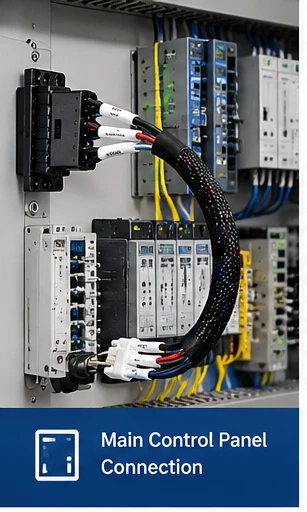
Inside the cabinet, an industrial wiring harness usually connects the PLC, I/O modules, terminal blocks, relays, power supplies and circuit protection. This specific type is often called a PLC control panel wiring harness. This kind of PLC control panel wiring harness is defined by accurate wire lengths, clear wire identification and tidy branching, because the technician who commissions the panel has to trace every circuit. We cover how to specify one in our guide to the PLC control panel wiring harness RFQ checklist.
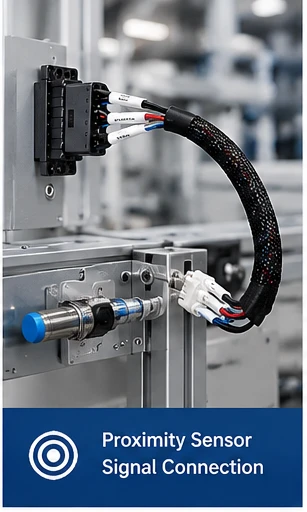
Outside the cabinet, a machine cable assembly takes over. It carries motor power, encoder feedback, sensor signals and communication to the devices spread across the machine. Here the cable jacket, shielding, connector sealing and flex behavior matter most.
A useful rule: if it is bundled wires held in place, it is probably a harness; if it is a cable that moves between devices and needs a connector at each end, it is probably a machine cable assembly.
How to Choose: Five Factors
01.Where will it run?
02.Will it move?
03.How noisy is the environment?
04.How much space and routing complexity is there?
05.How will it be serviced?
When a Machine Needs Both
Most projects that reach us involve both. A typical equipment build might use a PLC control panel wiring harness inside the electrical cabinet and several machine cable assemblies to connect motors, sensors and operator devices outside it.
Ordering them together has practical advantages. The same team confirms connectors, pinouts and labelling across the whole system, which reduces the chance that a cabinet harness and an external cable disagree about a signal. If your project also needs plastic or metal parts, we can coordinate them under the same purchase order.
Over 15 years of building custom assemblies for equipment manufacturers, we see the same avoidable problems again and again.
Calling everything "a cable."
A drawing that mixes cabinet wiring and external cables without separating them leads to wrong quotes. Split the design into the industrial wiring harness inside the enclosure and the machine cable assemblies outside it.
Leaving the environment out.
The same connector and pinout can need a different construction depending on noise, moisture, temperature and movement. Application-driven design starts with where the assembly will actually run.
Unconfirmed substitutions. Swapping a connector, terminal or wire type without approval can change fit, sealing or crimp quality. Substitutions should be agreed before sampling, not discovered at mass production.
Missing pinout or wire identification. Without a clear pinout table, reversed wiring becomes a real risk. Every pin should be verified against the drawing, whether the product is a harness or a cable assembly.
Sample and production built differently.
An approved sample only helps if production follows the same process, specification and team. We verify crimping, connector assembly, branching and shielding at the sample stage so the same method carries into volume.
What to Prepare Before Requesting a Quote

Whether you need cables, harnesses or both, the same basic information speeds up quoting:
A drawing, sample, photo, pinout table or application description. Incomplete information is fine; we fill in the gaps with you.
Connector and terminal part numbers, or brands you prefer.
Wire or cable type, gauge, length and tolerance.
Shielding, labelling and packaging requirements.
Expected quantity and target market, so we can align documentation such as RoHS/REACH declarations or UL reports.
For a full checklist, read our build-to-print RFQ guide.
How Mingching Builds Both
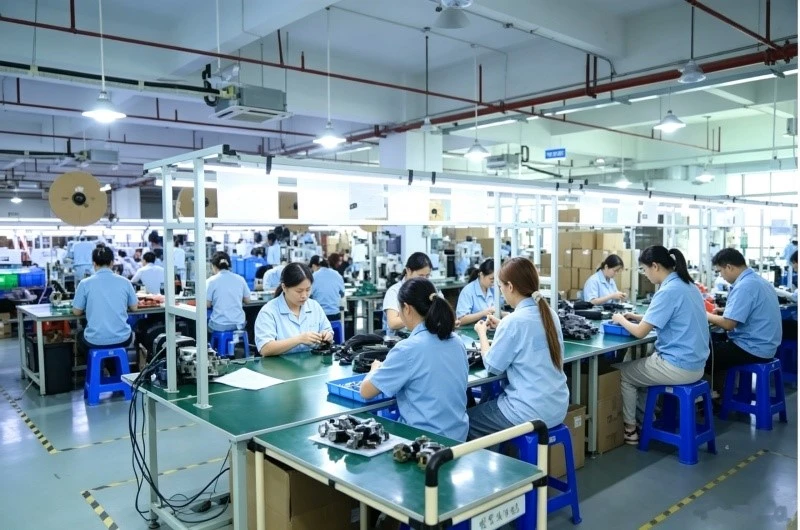
Mingching Electronics Technology Co., Ltd. was founded in Shenzhen in 2009 and has more than 15 years of experience in custom wire harnesses and industrial-grade cable assemblies for OEM customers, mainly in North America and Europe. Our quality system is ISO 9001 certified.
Our industrial wiring harness and machine cable assembly products follow the same controls: first-article and patrol inspection, crimp height and pull-out force sampling, pinout verification on every pin, and a 100% continuity test on every circuit. Hi-Pot, pull, IP67 sealing, temperature cycling and UV aging tests can be added per project. Samples can be ready in 7 days once the specification is confirmed, with a minimum order quantity of 10 pieces.
FAQ
Q: Is a cable assembly the same as a wire harness?
A: No, though the terms overlap. A cable assembly is built from jacketed cable with connectors, while a wire harness groups individual wires into a branched unit. Many products combine elements of both.
Q: Can one supplier make both a machine cable assembly and an industrial wiring harness?
A: Yes. We manufacture both, which lets one engineer manage connectors, pinouts and labelling across the whole system.
Q: Which is better for a PLC panel?
A: Inside the panel, a PLC control panel wiring harness is normally the better fit, since it follows the panel layout wire by wire. For cables leaving the panel to motors, sensors and other devices, use a machine cable assembly.
Q: Can you build from my drawing?
A: Yes. We build to drawings, samples, photos or a basic application description.
Talk to an Engineer About Your Machine Cable Assembly
If you are not sure whether your project needs a machine cable assembly, an industrial wiring harness or both, send us your drawing, sample or application description. One of our engineers will review it and follow the project from first email to delivery.